
DOE, CDC pilot EV charging station to make Clark ‘Greener’
By Shane F. Velasco
CLARK FREEPORT ZONE, Pampanga (PIA) – The Department of Energy (DOE) and the Clark Development Corporation (CDC) have launched a pilot charging station for hybrid and electric vehicles (EV) plying Clark Freeport Zone in Pampanga.
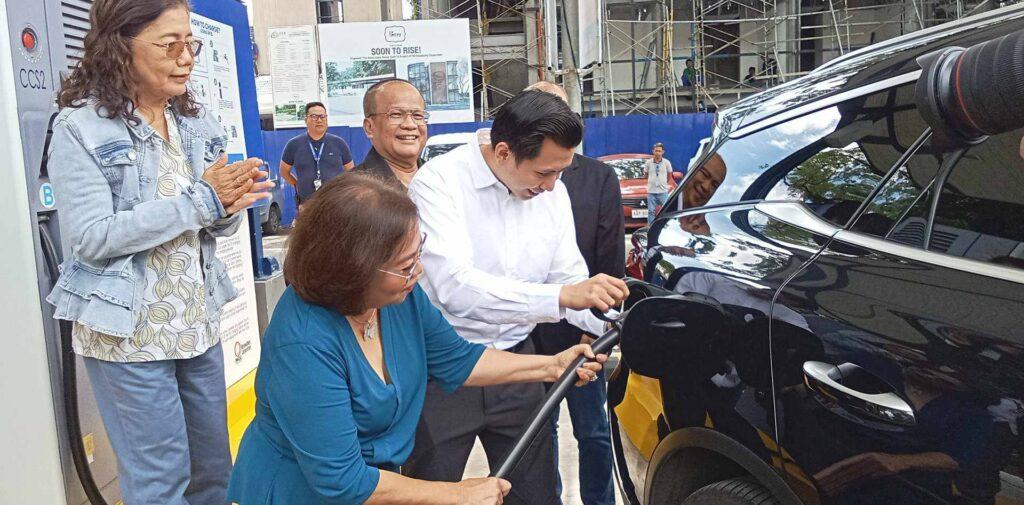
CDC President Agnes Devanadera said the initiative is in line with the agenda to make Clark a model green city.
“This project not only aligns with national energy goals, but is also expected to boost economic activity across sectors such as retail, amusement, gaming and tourism in the aspect of meetings, incentives, conventions and exhibitions (MICE),” she said.
The EV charging station, powered by solar energy, was installed through the support of the DOE and the Philippine National Oil Corporation Renewables Corporation (PNOC-RC).
It is the third facility of its kind inside the Freeport Zone after those in SM City Clark and Quest Hotel.
To encourage early adoption, free charging will be offered to the public until the end of June 2025, while commercial operations will begin in July 2025 to ensure long-term sustainability.
Devanadera added that as the Freeport Zone continues to position itself as a premier logistics hub, it is targeting an additional 60 megawatts (MW) of energy by 2030, on top of its current 130 MW consumption.
More locators and business establishments in Clark have begun shifting to hybrid and EVs amid the uncertainty of oil prices and to cushion its impact on their productivity.
For his part, DOE Director for Energy Utilization Management Bureau (EUMB) Patrick T. Aquino III has reported that there are already 1,062 charging stations for hybrid and EVs nationwide, including those installed by the private sector.
In 2024 alone, over 25,000 hybrid and electric vehicles are expected to operate across the country, which translates to a 170 percent increase from just 9,000 units in 2023.
Aquino encouraged the public to start considering using hybrid and EVs, as it is cheaper in terms of fuel consumption.
He explained that while a regular fuel-powered vehicle consumes P5.00 of fuel for every five kilometers, an EV would only consume P1.00 of electricity for the same distance.
The installation of more EV charging stations in many strategic areas is in line with the Comprehensive Roadmap on Electric Vehicle Industry, as mandated by the Republic Act 11697 or the Electric Vehicle Industry Development Act (EVIDA).
This initiative also supports President Ferdinand R. Marcos Jr. ‘s energy agenda, which aims to achieve 50 percent renewable energy share in the country’s power mix by 2030, in line with the 2023-2028 Philippine Development Plan. (MJSC/SFV, PIA Region 3-Bulacan)
##
